Service Details
A closer look at how each of our core investigations is planned and carried out.
Pre and Post Matrimonial Investigations

Matrimonial investigations are professional services used to verify the claims, character, and activities of a prospective partner or a current spouse. These are broadly categorized into Pre-Matrimonial (preventative) and Post-Matrimonial (corrective) investigations.
1. Pre-Matrimonial Investigations
The goal here is to establish a foundation of trust before "tying the knot." It is especially common in arranged marriages or relationships initiated through matrimonial websites.
Key Focus Areas
Background Verification
Verifying education, current employment, and actual salary/position.
Family Reputation
Checking the social and economic standing of the family in their neighborhood or community.
Character and Lifestyle
Habits like smoking, drinking, drug use, or gambling, and any hidden past or current relationships.
Financial Health
Assessing assets, liabilities (loans/debts), and overall financial stability of the individual and family.
Medical History
Uncovering chronic illnesses or mental health issues that might have been concealed.
Criminal Records
Searching for any past or pending legal cases/FIRs.
2. Post-Matrimonial Investigations
These are typically conducted when trust has already been compromised within a marriage. They are often used as evidence for legal proceedings like divorce or alimony cases.
Key Focus Areas
Infidelity (Adultery)
Discreet surveillance to catch a cheating spouse, often with photographic or video evidence.
Hidden Assets
Finding secret bank accounts, properties, or businesses, particularly during divorce settlements.
Abuse or Harassment
Documenting evidence of domestic violence or dowry related harassment.
Child Custody Support
Gathering evidence of a spouse's lifestyle or behavior to prove they are unfit for custody.
Suspicious Activities
Sudden changes in routine, unexplained work hours, or secretive phone behavior.
How Investigations are Conducted
We use a mix of on ground work and digital tools:
Surveillance
Physical shadowing (tailing) the subject to document their daily routine and meetings.
Digital Footprints
Checking social media, online activities, and public records.
Discreet Inquiries
Interviewing neighbors, colleagues, or friends of friends without revealing our or the client's identity.
Sting Operations
In complex cases, we may use undercover tactics to reveal the truth.
Corporate and Employee Background Checks
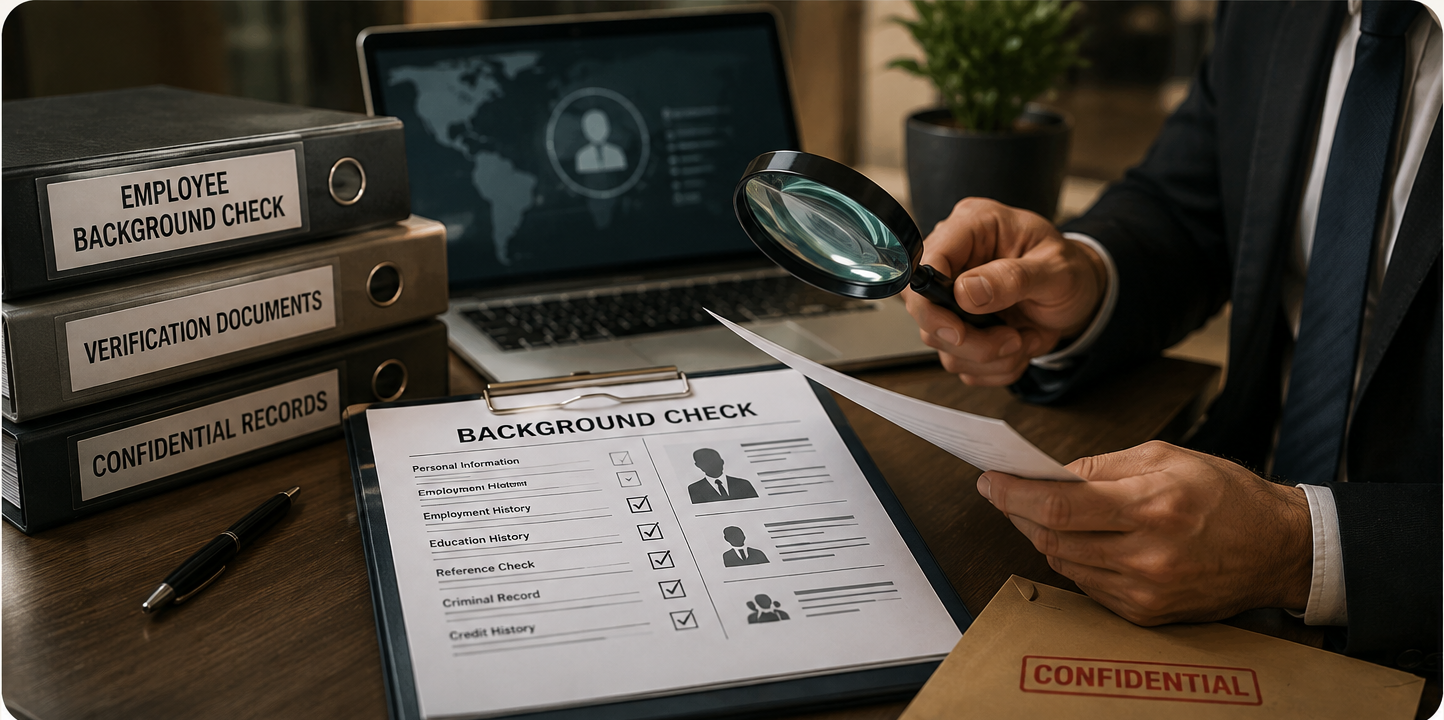
Corporate and employee background checks are a critical part of the hiring process and corporate due diligence. They involve verifying the accuracy of information provided by job candidates or assessing the integrity and reputation of a business, supplier, or partner.
1. Employee Background Checks
Performed on prospective employees to mitigate risks like workplace violence, fraud, theft, and negligent hiring claims. The scope depends on the job's seniority and sensitivity.
Key Verification Areas
Identity and Address Verification
Confirming the candidate's legal identity and current/previous residential addresses.
Educational Credentials
Contacting institutions to verify degrees, diplomas, and dates of attendance.
Employment History
Confirming past job titles, dates of employment, and any undisclosed gaps.
Criminal Records
Searching national, state, and local court records for convictions.
Reference Checks
Contacting provided references to gain insight into work ethic and character.
2. Corporate Background Checks (Due Diligence)
These checks focus on the integrity, stability, and reputation of a company or its key executives, often before mergers, acquisitions, or significant investments.
Key Verification Areas
Litigation History
Reviewing past and pending lawsuits involving the company or its directors/officers.
Regulatory Compliance
Checking for regulatory fines, penalties, or violations issued by governing bodies.
Financial Stability
Analyzing public financial statements.
Reputation and Media Check
Searching news and public records for negative press or controversies.
Corporate Structure and Ownership
Verifying shareholders and beneficial ownership to identify conflicts of interest.
Key Executive Integrity
Comprehensive checks on founders, CEOs, and senior management.
Surveillance and Evidence Collection

Surveillance and evidence collection are the core of private and professional investigations. These processes involve the discreet observation of people, places, or activities to gather factual, undeniable proof.
Objectives
The primary goal is risk mitigation, factual clarity, and building a record that can be relied on.
Objectives of Surveillance
Verifying Facts
Confirming or disproving claims about a person's activities, whereabouts, or associations.
Safety and Risk Mitigation
Identifying patterns of behavior that pose a risk to an individual, family, or business.
Financial Integrity
Establishing evidence around undisclosed transactions, assets, or misconduct.
Legal Compliance
Gathering documentation in a form that can withstand scrutiny in legal or regulatory proceedings.
Preventing Fraud
Avoiding costly mistakes, theft, or embezzlement through documented, verified evidence.
Key Methods of Surveillance
Our approach is tailored to the case, but generally draws on the following methods:
Physical Surveillance
Discreetly observing and, where relevant, following a subject to document daily routine.
Photographic and Video Evidence
Capturing time stamped, admissible visual proof of activity or meetings.
Digital Footprint Checks
Reviewing social media, online activity, and public records relevant to the case.
Discreet Inquiries
Speaking with neighbors, colleagues, or acquaintances without revealing our identity.
Professional Licenses and Records
Cross checking public records, licenses, and certifications relevant to the matter.
Reference Checks
Speaking with relevant references to gain subjective, corroborating insight.
The Evidence Process (General Steps)
Assignment Briefing
The engagement begins once the scope and objective of the surveillance is agreed with the client.
Reporting and Review
A detailed report with supporting evidence is compiled and reviewed against the client's objective.
Missing Person Tracing

Missing person tracing involves locating individuals who have lost contact with family or associates, whether due to voluntary disappearance, a family dispute, or other circumstances, using a combination of field investigation and lawful digital tracing methods.
Our Approach
Every case begins with a confidential briefing to understand the circumstances, followed by a structured combination of on-ground enquiries and remote tracing.
Key Focus Areas
Family Reunification
Locating individuals who have lost contact with family for personal or unavoidable reasons.
Runaway Case Investigation
Tracing minors or adults who have left home voluntarily, with sensitivity to the circumstances.
Address and Location Tracing
Establishing current whereabouts through field visits, local enquiries, and public records.
Verification of Well-being
Discreetly confirming the person's safety and current circumstances before any contact is made.
Coordination with Authorities
Assisting families in liaising with the police when a formal missing person report is needed.
How We Trace
Field Enquiries
Visiting last known addresses, workplaces, and known associates for leads.
Digital Trace
Reviewing public social media activity and lawfully available records for recent leads.
Discreet Circulation
Sharing photographs and identifying details discreetly within our trusted network.
Report and Handover
Documenting findings and handing over verified location details to the family or authorities.
Fraud, Cheating and Financial Investigation

Fraud and financial investigations focus on uncovering deception, cheating, and financial misconduct that has caused loss to an individual or business, building a factual record that can support recovery or legal action.
Our Approach
Each case starts with a review of the available documents and a clear understanding of how the alleged fraud took place.
Key Focus Areas
Business Fraud
Investigating fake investment schemes, forged documents, or fraudulent business dealings.
Cheque and Payment Fraud
Tracing bounced cheques, unpaid dues, and repeated payment defaults.
Identity and Document Fraud
Verifying the authenticity of identity documents, agreements, and signatures.
Partner and Vendor Fraud
Examining suspicious billing, diversion of funds, or breach of trust by business partners.
Asset Tracing
Locating concealed assets, properties, or bank accounts linked to the fraud.
Investigation Process
Case Assessment
Reviewing available documents and understanding the nature of the alleged fraud.
Verification and Field Checks
Cross-checking claims against public records, registries, and field visits.
Evidence Compilation
Assembling documentary and testimonial evidence in a clear, usable format.
Reporting for Action
Delivering a report suitable for legal, recovery, or negotiation purposes.
Cyber Investigation and Digital Footprint Analysis
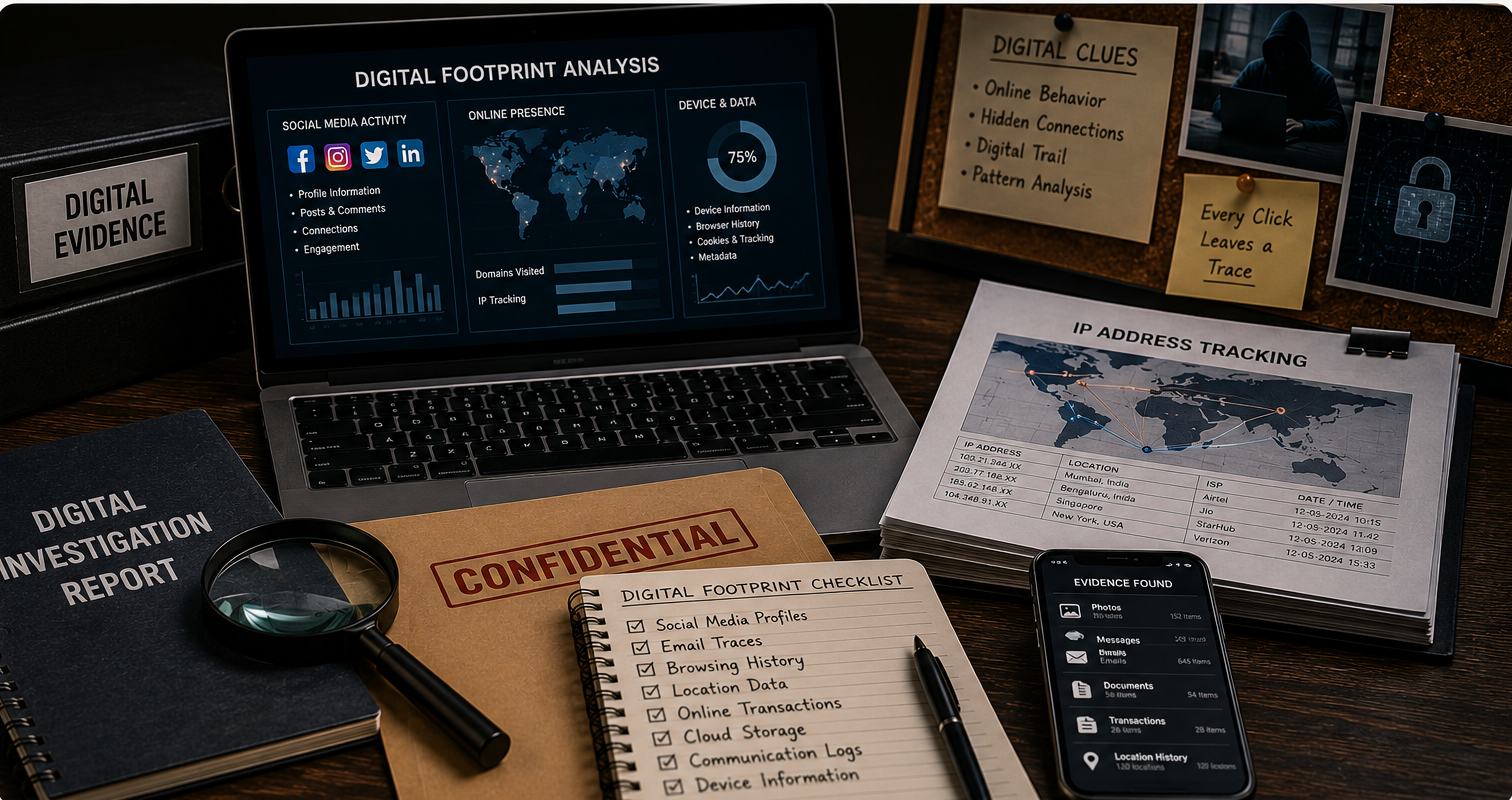
Cyber investigation examines a person's or entity's online activity and digital presence to uncover facts relevant to a case, ranging from harassment and impersonation to online fraud and concealed communication.
Our Approach
All findings are gathered through lawful, publicly available sources and documented in a form suitable for legal, HR, or personal use.
Key Focus Areas
Social Media Investigation
Reviewing public profiles, activity patterns, and connections relevant to a case.
Online Harassment and Impersonation
Investigating fake profiles, cyberstalking, or defamatory content.
Digital Communication Review
Examining relevant, lawfully accessible communication metadata for a case.
Online Fraud Tracing
Investigating fraudulent websites, phishing attempts, or online payment scams.
Device and Account Security Review
Assessing exposure from compromised accounts or devices.
Our Approach in Detail
Footprint Mapping
Building a picture of a subject's known online accounts and activity.
Evidence Preservation
Capturing and timestamping digital evidence in a form usable for legal proceedings.
Source Verification
Cross-referencing digital findings with public records and field enquiries.
Reporting
Compiling a clear report of findings for legal, HR, or personal use.
Tracing Loan Defaulters and Recovery Support
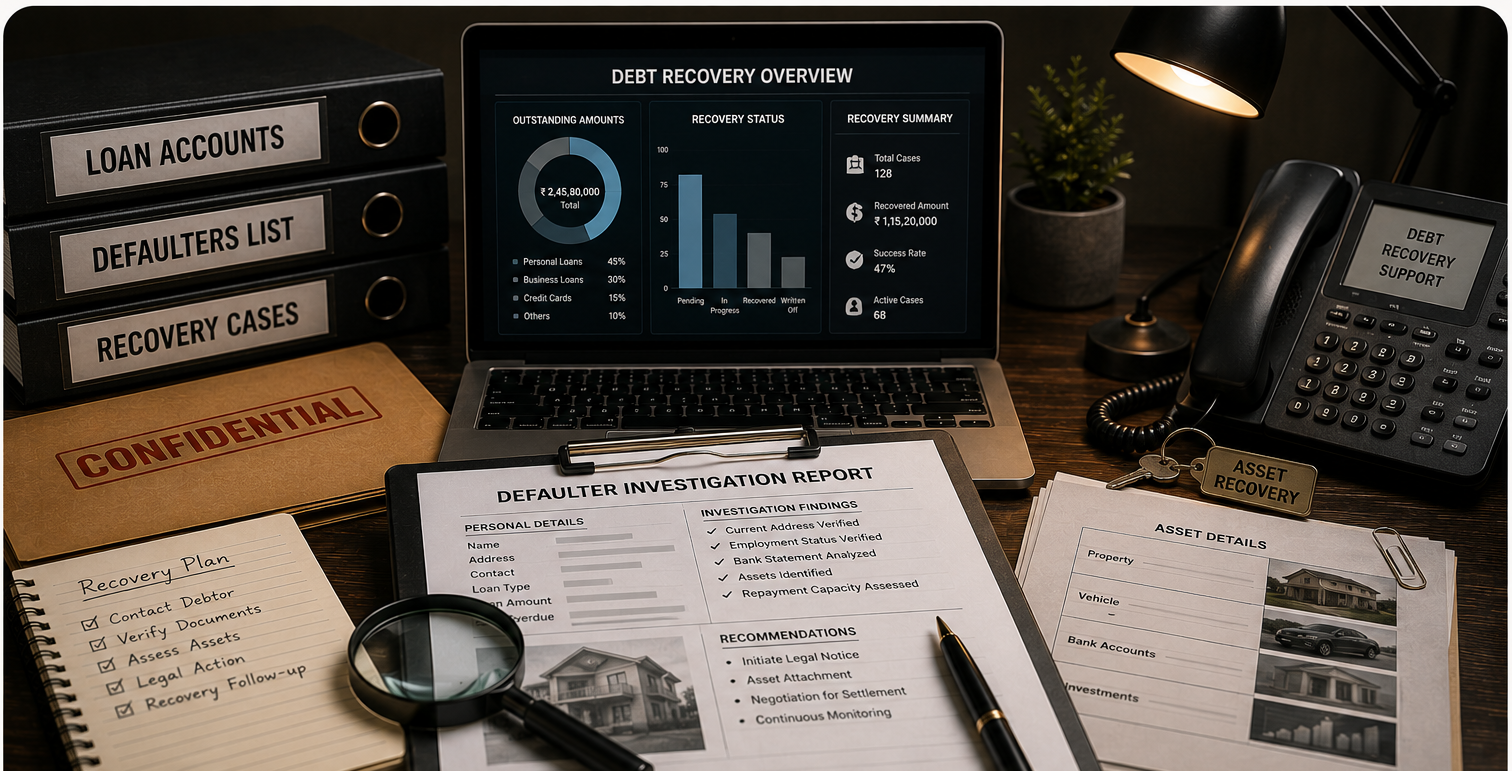
We handle cases related to tracing loan defaulters who are currently untraceable and are not paying their loan EMIs. Our team investigates, traces, and submits a detailed report to the concerned bank with verified information regarding the defaulter's whereabouts and status.
Our professional fees for tracing services are charged as per the scope and complexity of the assignment. In case the bank also requires assistance with recovery of funds, the approach and execution process would differ and will be handled on a case to case basis depending upon the nature of the matter. For tracing only assignments, we charge an advance of 50 percent of the mutually agreed professional fees at the time of assignment confirmation.
Kindly let us know your decision and the expected commencement date so that we may allocate and brief our team accordingly.